
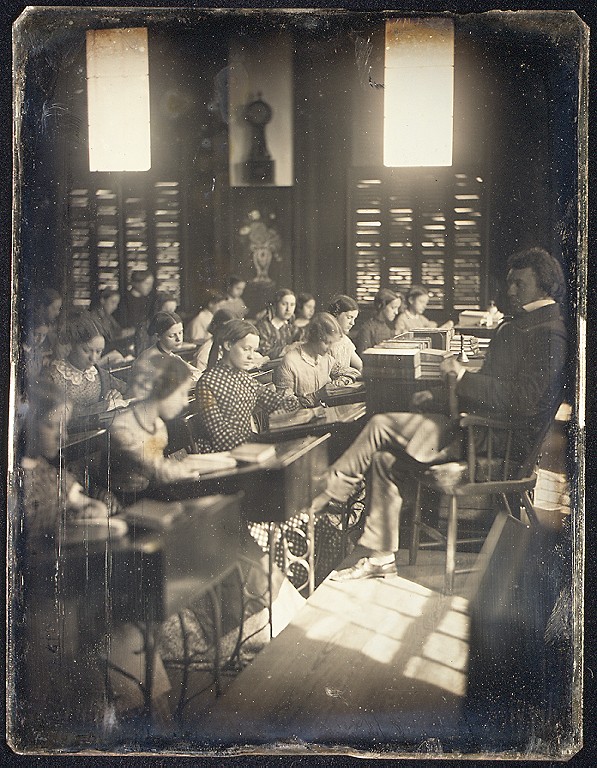
It was the end of a long day when my fellow English teacher and I stood in a destroyed but quiet classroom behind matching desks and enjoyed the companionship of adults. She looked pensive, more so than usual, and she began to tell me a story about her husband, a professor at the local college in the town where we worked. She was a part-time professor there too, and they had a spunky little girl who combined the wildness and charm of both of them. I particularly admired my colleague because she had such a happy marriage with a cherub for her and her husband to share, and they lived in the all-encompassing world of academia.
Why she was teaching middle school in a private K-12 country day school was beyond me. I understand it’s hard to get college jobs, but that seemed like a strange stretch of skills and patience. However, she had both and did okay. I had talked the principal into letting her have the upperclassmen because they were much closer to what life was like at college. I’m not so sure she liked the change, but she was adaptable–at least, as long as I was there. She quit the same year I did.

Anyhow, she told me that her husband had encountered a student in one of his classes that seemed to be a little “different” than most. She claimed to have a special relationship with my colleague’s husband and that they were close. Too close? She would write to him, stay after class, and her husband talked to her about the strangeness of how the woman was treating him as if they had something going on when there so obviously wasn’t.
My colleague was unnerved, I could tell, by this encounter, and I could understand why. Her husband was obviously doing nothing and was highly devoted to his free-spirited wife, enough to where he told her what was going on. I’m sure he was uncomfortable, too, as this woman’s emotions became more transparent and approval-seeking. She frowned as she explained that this woman saw herself in a relationship with her husband. How can this be?
“Well, be careful. The ‘relationship’ is real to her,” I intoned, intuiting more than I could truly explain to my fellow teacher. “In her mind, [your husband] has been sending her signals and signs, and she really thinks he has feelings for her.”
She looked at me strangely, wondering how someone could think there was a relationship when there truly wasn’t. Was her husband doing something to “egg” this woman on? He didn’t have to be at all. I brought up the term Erotomania, and she looked it up as I talked to her about what this woman could be thinking. In this student’s mind, this professor shared her feelings, and it would feel “natural” to her that they were together, if only privately or for short sprints of time. My colleague was fascinated because most people don’t encounter this phenomenon.

Almost everyone has had a crush or infatuation of some kind as one grows older. As much as that is normal, some people have a disorder where their crush becomes more than just that; it is conceived as a relationship built on stalking and fantasy. Moreover, erotomania is a type of disorder where a person focuses on someone as a love interest and believes that his/her interest is returned when it isn’t. The focus is so intense, though, and real to the subject that simple things can show how much a person loves him or her back. Even negative attention is misconstrued as a signal of love. The normalizing of fantasy becomes full-blown, and one thinks the relationship is central and strong.
I wish I could just say that it was intuition and my degree in Psychology that allowed me to understand erotomania, but that isn’t the only truth. I suffer from this myself. When I moved to Bellwood and started the 2nd grade, I met a boy who would stay in my thoughts for 40 years. In 4th grade, I remember rollerskating around in front of my house, thinking of this young man and wondering why I couldn’t get him out of my thoughts. I stopped skating abruptly as my mind cleared, and I made a stark realization at such a young age: this is what love must be like.
If he looked at me, then he must love me. Even as a young child, I realized that my thoughts may not be accurate, so I would ask friends and family that went to the school, too, if they thought he liked me. Most said they didn’t think so, and my brother, who was in the school’s band with this boy, clearly stated that the kid didn’t like me. However, I always had a reason they were all wrong: they were racist people who felt a girl of color and a white boy shouldn’t be together, and my brother was just being a jerk to me. That would be nothing new. Another Black girl that went to school with me, she and I were the only people of color for years, told me that she thought he saw me as “hot to trot.” I had no idea what that meant, and she explained he thought I was sexy. That reinforced my thoughts that he liked me and that he was just shy and chased around other girls because he wanted to make me jealous.
I kept a journal where I described fellow classmates, and he was saved for last. I wrote pages and pages of what he did in school. I tried to give him a note through a friend, and he said he’d thrown it out. He said this to her. I figured he threw it out thinking the note was from her and it had nothing to do with me. I had a friend give him a Valentine’s Day card in 7th grade that I had taken hours to pick out and inscribe. A girl in his class came to me and said, “You know that he’s going out with [so and so], right?” I pretended that I didn’t know, but I did. I just didn’t take it seriously, as he had to be as in love with me as I was with him, and we were trapped in a world that didn’t appreciate interracial romance. He had to go for the pretty blonde at the time because it was more acceptable.
I told myself many lies to keep the fantasy of this love affair alive. It felt satisfying until it wasn’t. When I went to a different high school, I suffered deeply. I fell into a deep depression and didn’t want to talk to anyone or do anything.

In gym class, the ball would sail past me as I sat there glumly, not caring that the girls yelled at me. I finally started talking to a girl who would be a friend for years before she moved back to India, and I told her about the boy and my love affair. I showed her his 8th-grade picture in my yearbook, and she was impressed, almost to the point that I was angry that she thought he was so hot.
I saw him twice after middle school. Once I had taken my sisters and their friends (who were also sisters) to McDonalds for a snack. He was there with his 8th grade girlfriend and a friend of his. I ignored them, offended that my love would be with someone else. My sister nudged me and whispered, “He’s looking this way.” I shrugged my shoulders and kept eating my sundae. They followed us for a while and I couldn’t stand to see him with the girl for too long and I left them to go home. The same sister who had whispered before told me he showed up at the same park we played at and was kissing the girl. I was glad I didn’t stick around. The next time I saw him he was in front of me in the same McDonald’s drive thru. I was looking at this boy’s face framed in his rearview mirror thinking he’s the best looking boy I had ever seen. It had been years since I’d laid eyes on this boy, and I almost had a heart attack when I realized it was him. He stared back at me and looked terrified. Perhaps I was too good a stalker?
Memories
Forty years later, he is still on my mind even though I’m married and lots of life has happened. I tried to find him about 10 years ago, and I happened to mention that I wrote him a note to my doctor, and she immediately said don’t ever do that again. That’s when I realized it wasn’t just a note or some harmless gesture; I was contacting someone who hadn’t thought about me in 30 years. We weren’t friends in school and ran in different crowds altogether. He had 3 girlfriends (that I knew about) between 5th and 8th grade, none of whom were me. They didn’t even look like me, with all 3 being pretty blondes. So why did I think he’d be dying to see me again and hear from me? He has a type as he’s been married for over 20 years to a pretty blonde and has two children. Don’t ask me how I know…
What is Erotomania?
It’s three times more likely to involve women admirers than men. Most likely, this type of disorder would start just after puberty, when concepts of love and an idealized love object would take shape. For me, it started a bit sooner than that. Some people seem to be able to form these types of bonds before puberty. Mary V Seeman, Professor Emeritus in the Department of Psychology at the University of Toronto, Canada, in her article “Erotomania and Recommendations for Treatment,” asserts that wanting to be loved isn’t such an outlandish desire. Still, the idea that one is in a loving relationship with someone who doesn’t even realize it or possibly even knows who one is shows the “mania” portion of the disorder. The admired is usually someone of a higher social status, like a star or someone famous, and the feelings of admiration and love increase as these characteristics in the admired do:
- physical attractiveness
- perceived authority
- socioeconomic status
- general renown
(Seeman, 2015). A professor would definitely have the “perceived authority” and “renown” to trigger this phenomenon. For myself, I was a child, and so was he when this was triggered for me. However, I did perceive him as one of the more “popular” boys in the class, and I predicted his future success, which he has found as an adult. Also, I thought he was the best-looking boy I had seen then; in other words, physical attraction was a big deal.
The disorder comes with its delusions. The admirer usually faced social rejection or isolation with little to no relationship experience. To save some self-love, they resort to fantasy and imagine that a “superior being” loves them and is as committed as they are. Due to this preoccupation with a need that isn’t being met, the admirer becomes overly interested in their own needs and hyper-aware of what they deem as romantic cues, be they positive or negative. The professor gave no sign to his admirer of a loving relationship, yet his student figured things out in her own way and assigned any and all gestures to romance despite the lack thereof. It was the same for me. Any look I got was his admiration of me, also. I sent him notes that he openly rejected, but I made excuses for why he would do so. He was terrified of me, and I imagined it was because he was so attracted to me that he didn’t know how to handle it. However, I was a stalker that I’m sure he didn’t know how to handle at such a young age. I didn’t even realize this until the doctor told me to never write him again; I thought my letters were going to someone who had feelings for me, too. I didn’t see myself as a stalker until it was years and years later.

Mainly, this disorder occurs when someone faces “heightened emotional distress,” a recent loss of some kind, or other emotional vulnerability. The student mentioned earlier might have been distressed at dealing with the class the professor was in charge of or college life in general. I can’t remember any distress I felt when I started feeling things for this boy in 4th grade, but I stated that I was the only one of two black children in my class. This can easily lead to feelings of social rejection and isolation that would have me attached to what I perceive as a romantic ideal and who might have shown some interest–or none, but I perceived it anyway.
For such a vulnerable person, perception is faulty at best and downright wrong at worse. There’s lots of “wishful thinking” and imagining what seems just within reach when it isn’t. Unfortunately for myself (and I hope NOT for that student), the delusion of affection can become “fixed” as it can serve an “important intrapsychic purpose.” For me, the boy I thought could secretly love me too became a permanent dweller of my dreams and fantasies and has never left my side, virtually. That may be why it was hard for me to perceive that he doesn’t even know who I am anymore. For that student’s sake and the family that she could affect in more ways than one, I hope that she can break free of the delusions before it becomes the support that she feels she needs and can’t live without. These imagined affairs aren’t just bandaids; they are your self-esteem. Someone of such grandeur loves you, and therefore you are as “grand.” Suddenly, you are on top of the world, and you don’t want a therapist to pull you back into reality. There’s only one problem: it’s a long way down when you fall–and you will, one way or another.
The Erotomaniac (that seems a strange thing to be called) is naturally isolated, and this only serves to reinforce the delusions as they don’t have to answer questions or revise their dreams to match a reality that is forced upon them.
Egocentric bias or self-centrality refers to the assumption that one is the center of all actions, and gestures must refer to oneself. When this boy looked around when my class was walking by, it was to look for me, of course. It would never occur to me that he would have any other intention.

One would think that a person suffering from this type of disorder would have low self-esteem since one is using the love object as an esteem booster. However, low self-esteem does not mean the person isn’t self-focused or self-absorbed. There’s even something called intentionality bias that happens where nothing is just a natural occurrence but is meant to form messages from the universe or whomever. If we ended up in the same place, it was an opportunity or a sign. I didn’t believe so much in that as I knew we lived in the same area and went to the same elementary and middle school. We were supposed to attend the same high school, but his parents put him in a private school.


According to an article by Gaia Sampogna et al. in the International Review of Psychiatry in 2020, this condition is “chronic” and resistant to treatment because of the need for the love object.
The delusions create faulty or false perceptions where all actions by the love object are seen as amorous, including refusals and negativity. The erotomanic is happy in the delusion and experiences a heightened ego and sense of self–so why would this person seek help? This disorder doesn’t cause bizarre delusions or overly erratic behavior. How many people on social media stalk their friends, interests, exes, etc.? Most people try to read “signs” and “guess” what someone feels about them; they just aren’t delusional about it and will not have this type of fake relationship that occurs in isolation.
So How Does Someone Get Treatment?



Trust. The difference for someone with this disorder can be how well they trust the person attempting treatment. The imagined love affair serves a strong purpose for them by tackling incompleteness, unworthiness, rejection, and loneliness. Why would one seek help if the love object and interest are fulfilling their needs? After a while, admiring from afar won’t be enough, and the admirer will want physical closeness. That will not happen because the love object doesn’t even know they’re in this type of relationship. The letdown can be catastrophic to the admirer’s ego.
However, it’s a necessary evil. The admirer can’t go on in an irrational, “fake” relationship no matter how good it makes them feel at the time. As therapy begins, it’s important to build up the admirer’s self-esteem through understanding, emotional support, and social and emotional skill building.
Once trust is established between the admirer and their therapist, the admirer has to tell their story in full detail. Between them and the therapist, they will hash out the cognitive biases, the impulsive conclusions, the wrong interpretations, and the egocentric delusions and set the record straight where it had not been before.



An admirer has to learn that stuff can happen just by chance and have nothing to do with them. They need to go back through their “playlist” of signs and romantic gestures and realize what they really were, their egocentric cognitive tendency to centralize their involvement and cognitive bias that makes them think it’s all about them no matter what.
This sounds easy, but it’s destroying a narrative someone has lived with and believes in. Years could have passed or simply days, but the story is central and tied to someone’s sense of self. The longer the fantasy has survived as someone’s supposed reality, the harder it will be to be pulled back from the edge–or to be fished out of the abyss, if it comes to that. And just think: the person being rescued will resist the rescue!
This type of disorder isn’t a diagnosis in itself (the DSM-V has it under delusional disorders, and schizophrenia has to be ruled out; the difference is that erotomania doesn’t have prominent hallucinations, and the delusions that have taken hold are only related to the admiration and nothing else). In fact, most who suffer from this disorder (including myself) still function and don’t show overtly bizarre or odd behavior. The mania tends to be in short periods or blips and related only to how long we are in the holds of the fantasy. Depression is nothing new for this disorder as this is a natural inclination for the admirer, and the fantasy depends on keeping the delusion alive. Most admirers are resistant to letting go and allowing treatment to take hold.
Treatment could include cognitive behavior therapy, medication, and some risk management for stalking and harassing behavior that could be taking place. Therapy has never worked for me, as I expect too much from it. I suppose romantic relationships aren’t the only ones I have high demands for. Medication has helped me with anxiety and keeping the runaway thoughts from controlling me. I have learned what haunts me–my own irrational attachments. When I saw the ghost that haunts me, it became the grown-up version of the boy, drenched and stiff, following me no matter what other relationships I have or where I go.
About the time I tried to contact my love interest, I started having dreams that he was chasing me. In the dreams, I just knew that I had to get away from him, and I would do anything to get away. Other players in the dream have warned me he’s coming and we all go running off.
I’m not sure what I thought he was going to do when he caught me, I just knew I had to get away. I used to wake up wondering why I would want to escape from the boy I thought I loved. Then I realized that it wasn’t him I was trying to escape from but the irrational love that consumed me and took up too much of my time and energy. Subconsciously, I had realized that my delusions were trapping me and I wanted out. The dreams went on for years, until I couldn’t escape anymore. He used to be far behind me and I could easily outrun him. Then, it seemed he’d be right behind me and tackle me immediately, not letting me up no matter how I screamed and fought. I suppose my subconscious self was desparately trying to work out my delusions and showing me how strong and dangerous they were. That’s all I felt in those dreams–danger.
BTW

Thankfully, I have some insight into why I’ve held on to feelings that should long ago have dissipated as a first crush and nothing else. I hope that that student also learns to deal with her feelings and not disrupt the life of a happy family too much. Though I still have lingering moments of delusion, I promised myself there would be no contact with the young man who is now older with kids the age we were when my delusion was in full swing. I only wish him well.
References
Seeman, Mary V. “Erotomania and Recommendations for Treatment.” Psychiatric Quarterly. 6 Oct 2015 87: 355-364.
Sampogna, Gaia, Francesca Zinno, Vincenzo Giallonardo, Mario Luciano, Valeria Del Vecchio and Andrea Fiorillo. “‘The de Clerambault Syndrome’: more than just a delusional disorder?” International Review of Psychiatry. 2020. 32.5-6: 385-390.






































































 And Yet...She Persisted